Posts

Basic chmod examples

Image
In our previous post we discussed how to change the permission or mode of a file with chmod command. Now lets see few basic examples regarding how to use chmod via Command Line Interface

How to change the permission of a file in Linux?

Image
In the last post we discussed about the basic file permission. Now lets see how to change the permission of a file or a directory in Linux. To change the access rights we use the chmod command.

Linux File Permissions - Basics

Image
In a multi-user operating system, there will be more than one user account probably handled by different users. What would happen if all the user accounts have permission to access each and every file or command in an operating system? There is a chance for a complete disaster. To avoid such a scenario filesystem has a method to assign access permission to specific system users and groups. The ability of a user to  view, modify and run a particular file or a directory depends upon this access right.

Linux user management - Create, Remove, modify an user account

Image
User Management is one of the major responsibilities of a System Administrator. The user can either be an account associated with an application or a human being. This post shows how a user account can be created, removed and modified via CLI.

List of alternative Linux/Open-source software

Image
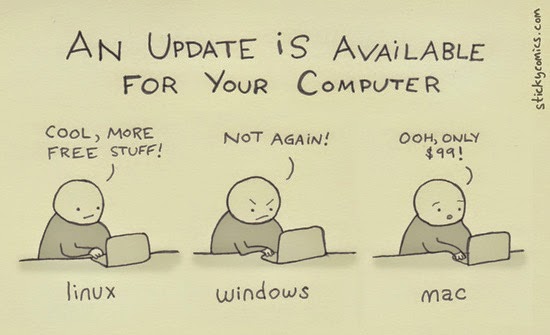
"There are moments in our lives when we find ourselves at cross roads. The choice that we make in those moments can define the rest of our life". At some point you might get fed up with proprietary OS/software and will start thinking about switching to Linux/open source software. Only thing that holds you back is the doubt whether there are any alternates to the software that you have been using for long. This post is intended to address such doubts. credits: stickycomics.com

what is UID and GID in Linux?

Image
In order to log into a Linux computer you would require a user account. Once you log in to the computer you can access the files and folders available in the computer. In a Linux  system, each user is identified by the kernel with a number called User Identifier or UID. During user creation the system generates a UID and maps it with a username. The /etc/passwd file contains UID to username mapping of all users in the system. In most Linux operating system the value  of UID lies between 0 - 499 for system generated users and  500 - 60000 for new users created. The default UID of root user is 0.

echo command

Image
echo is a command used to print a line of text or a string to the terminal. echo command is not limited to *nix operating system. They are also used in other operating systems like Unix, DOS, MS  Windows etc. In Linux echo is usually used in shell scripts to display output while running a script. The syntax of echo command is as follows